
By Andreas Yilma, Staff Writer, CT POST
June 13, 2026
BRIDGEPORT — In a city with Connecticut's lowest tree canopy coverage, a new waterfront experiment is taking root that supporters hope will bring environmental and community benefits.
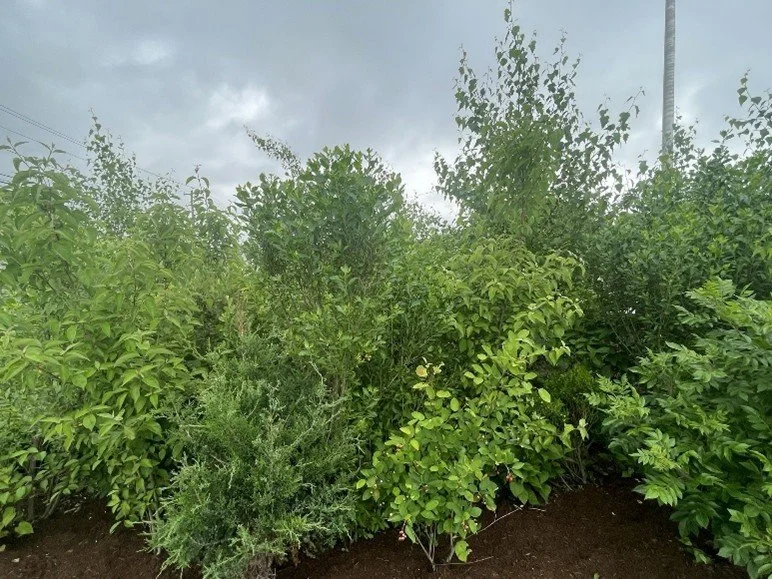
The Aspetuck Land Trust has planted what it says is the largest Miyawaki forest in the Northeast at Seaside Park, a dense, 12,000-square-foot microforest made up of 6,000 native trees, shrubs and ground cover plants representing nearly 40 native species.
Called Miyawaki by the Sea, the project will test whether an unconventional Japanese afforestation method can help address some of Bridgeport's environmental challenges, including flooding, poor air quality, extreme heat and a lack of green space. Advocates say the Miyawaki method produces forests much faster than conventional plantings of native trees, which can take decades to mature.
The project has drawn interest from researchers at Yale University, Harvard University and other institutions, who will help study the site's ecological development over time.
Marlyse C. Duguid, a senior lecturer and a director of research at the Yale School of the Environment, said students helped plant and map the forest. Every tree has been tagged and recorded using high-precision GPS equipment, allowing researchers to track growth, survival rates and ecological changes.
Duguid said there have been few peer-reviewed studies that follow Miyawaki forests over time, and she has not seen substantial data supporting claims that Miyawaki forests can reach the maturity of a typical 150-year-old forest in roughly 20 years, a claim often made by advocates of the method.
Having individually mapped trees will provide researchers with substantial information about how the forest develops, she said.
The Seaside Park site includes 12 research plots using different planting densities. One-third were planted in the dense Miyawaki style, one-third at a moderate density and one-third using more traditional spacing, allowing researchers to compare how the different approaches perform over time.
Researchers expect to have initial survival data by next summer.
"Big environmental problems like climate change ... need creative solutions, and so this is a really unique and interesting solution," Duguid said.
Miyawaki by the Sea was planted in November 2025 between Barnum Boulevard and Barnum Dyke near Seaside Beach using native coastal species selected for their ability to tolerate flooding and salt exposure. Species include swamp white oak, red maple, black cherry, dogwood, witch hazel and beach rose.
The land trust held a ribbon-cutting ceremony for the Seaside Park forest Friday morning, attended by state and local officials.
The project comes as Bridgeport continues to grapple with significant disparities in tree coverage.
Bridgeport's tree canopy covers 22% of the city, the lowest percentage in Connecticut, according to the state Department of Energy and Environmental Protection. By comparison, neighboring Easton has 71% tree cover, while Hartford has 25% and New Haven has 31%. Statewide tree cover averages 74%, while New England averages 81%, according to DEEP's media relations manager, Bill Flood.
Tree cover drops into the single digits in parts of downtown, the East Side and the East End, Flood added.
Aspetuck Land Trust Conservation Director Mary Ellen Lemay introduced the idea after learning that Biodiversity for a Livable Climate planted the Northeast's first Miyawaki forest, a 4,310-square-foot project at Danehy Park in Cambridge, Mass., in 2021.
"A lot of people have been doing these concentrated tiny forests, and I said, 'Wow, that would be a great application for the city of Bridgeport because it has the lowest tree canopy in the state of Connecticut, the highest impervious surfaces and a lot of flooding that occurs there,'" Lemay said.
The Miyawaki method was developed more than 50 years ago by Japanese botanist Akira Miyawaki. Rather than planting trees with traditional spacing, the technique packs native species closely together, creating multiple layers of vegetation from the outset.
Advocates say the dense planting accelerates natural forest development. Instead of progressing through decades of ecological succession — from grasses to shrubs to mature trees — the forest is designed to establish those layers simultaneously.
"It's like stacking the deck in your favor," Lemay said.
Miyawaki used the method throughout Japan, including on former industrial sites associated with companies such as Toyota and Nippon Steel.
While advocates tout the benefits of Miyawaki forests, the approach also has drawbacks. The dense plantings are more expensive than traditional reforestation projects, and because the method is relatively new in the Northeast, there is limited scientific evidence about its long-term performance in the region.
For Aspetuck Land Trust, however, the project's value extends beyond the scientific study.
Executive Director David Brant said the organization hopes the forest will demonstrate how nature-based solutions can improve quality of life in urban communities.
"Nature is the common denominator for all of humanity, and there's just not enough of it in Bridgeport," Brant said.
Unlike a single street tree, he said, the forest functions as an ecosystem. Multiple layers of trees, shrubs and ground cover create habitat for wildlife and may provide benefits such as stormwater management, cooling and increased biodiversity.
The Seaside Park project is not the organization's first Miyawaki forest.
Between 2023 and 2024, Aspetuck Land Trust planted seven small Miyawaki forests at Bridgeport elementary and middle schools through a state climate-smart agriculture and forestry grant. The organization said those were the first Miyawaki forests planted in Connecticut.
The school forests range from about 100 to 1,100 square feet and have already experienced significant growth, according to Lemay.
She said one of the most surprising outcomes has been their resilience during recent drought conditions.
"When we had these droughts, I was panicked because I thought all these little forests were going to die," Lemay said. "When I showed up, they were thriving, and all the grass around them was dead."
Bridgeport Sustainability Manager Chadwick Schroeder said the success of the school forests prompted city officials to support a larger project on public land.
Seaside Park offered an opportunity to address flooding, water quality and habitat concerns while connecting residents with the waterfront, he said.
"Too often, the natural environment is disconnected from residents, or there's pollution or industrial development on our waterfront that restricts residents from accessing it in a clean and healthy way," Schroeder said. “So this not only allows people to connect with nature, but it’s going to attract songbirds, it’s going to attract butterflies, and it’s also right next to where our parks and rec summer camp is.”
Advocates say projects like the Seaside forest could help address environmental justice concerns in Bridgeport and across Fairfield County.
Jhoni Ada, conservation community organizer for Sierra Club Connecticut, said Fairfield County continues to struggle with poor air quality, while Bridgeport faces higher rates of childhood asthma than many other parts of the state.
"Bridgeport has some of the largest child asthma hospitalizations in the state, and for that reason alone, we should be looking at trees as a solution," Ada said. "Not just because they support wildlife, but because they're literally supporting the lungs of our kids."
Sarah Lawson, a Quinnipiac University professor of biological sciences and director of environmental science and studies, said native plantings can help manage stormwater by improving soil stability and increasing water infiltration.
She added that green spaces can provide measurable mental health benefits and create places for people to gather outdoors.
Studies have linked time spent in nature to reduced stress levels, lower heart rates and improved overall well-being.
"This initiative is thinking about bringing back native plants but also bringing an area for people to meet and build community around being outside," Lawson said.
Aspetuck Land Trust hopes the Seaside Park project will inspire similar efforts elsewhere.
The organization is planning two additional Miyawaki forests, including a 3,000-square-foot planting along the Pequonnock River at The Knowlton this fall and a proposed 9,000-square-foot forest near Norwalk High School next spring.
Ultimately, Lemay hopes the forests will become a tool municipalities, organizations and homeowners can use to restore nature in places where traditional reforestation is difficult.